MAGA Inc.: Energy Transfer
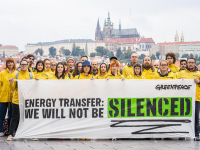
Photo: Ray Baseley, Greenpeace
Energy Transfer LP, which is based in Dallas, Texas, is one of the five biggest pipeline companies in the U.S. with a presence in 44 states (predominantly in the Texas-Oklahoma-Louisiana corridor) as well as internationally. It specializes in “transportation, storage and terminaling for natural gas, crude oil, NGLs, refined products and liquified natural gas.”
(Click here for the table of contents of MAGA Inc.: A Guide to Trump's World of Crypto Czars, Tech Titans and Prison Profiteers.)
The month after Trump was inaugurated, Energy Transfer executives told investors that they had received requests to power 70 new data centers.
Here are some of the largest new projects that Energy Transfer is potentially providing power to in the state of Texas:
1. Abilene: Stargate Data Center: The power sources for Stargate have not been named, but analysts at East Daley Analytics, a Colorado-based energy intelligence firm, note that it is strategically located on the path of Energy Transfer’s new Hugh Brinson pipeline, which is under construction to transport gas from the Permian Basin in West Texas to the Dallas area.
2. Amarillo: Fermi Data Center: Oracle has contracted with Energy Transfer to help supply 2.3 gigawatts of energy to Fermi America’s 11 gigawatt data center (also known as the President Donald J. Trump Advanced Energy and Intelligence Campus), which is expected to sprawl over 18 million square feet. (If completed as planned, it will become the world’s largest data center.) (Fermi America is run by Rick Perry, Trump’s former Energy Secretary, and a board member of Energy Transfer.)
3. New Braunfels/San Marcos: Highlander Data Center: A start-up named CloudBurst is building a 1.2 gigawatt data center just outside of San Antonio in collaboration with Energy Transfer.
The new projects are stirring tensions in the small rural communities that the data center companies have targeted.
Kelcy Warren & Rick Perry Kelcy Warren, CEO of Energy Transfer, is the largest energy-sector donor to President Trump. He donated US$250,00 to Trump’s first inauguration in 2016. Just four days after Trump was inaugurated for the first time, he signed an order to allow Energy Transfer to complete the highly controversial Dakota Access Pipeline that had been suspended by the Obama administration following massive protests over the pipeline's impact on the sacred lands of the Standing Rock Sioux tribe. In 2020, Warren collected US$10 million in donations for Trump at a fundraiser at his home in Dallas. Warren continued to donate lavishly to Trump with a US$5 million gift to Make America Great Again Inc. for his 2024 presidential run, bringing his personal contributions to Trump to US$20 million. Energy Transfer also boasts other close Trump connections. Rick Perry, who Trump appointed as U.S. Secretary of Energy from 2017 to 2019, served as a member of the board of directors of Energy Transfer directly before and after serving in the U.S. cabinet. When Perry was in charge of the Department of Energy, he pushed for deals in Ukraine, including one to contract Energy Transfer to provide a terminal to transport US$20 billion in gas from Louisiana over 20 years, according to an investigation by ProPublica, Time and WNYC. |
“It has completely changed the way we were living,” Arlene Mendler, who lives opposite the Stargate complex in Abilene, told the Associated Press news agency. “We moved up here 33 years ago for the peace, quiet, tranquility. After we got home from work, we could ride horses down the road. It was that type of a place.”
“It just sucks, they’ve come in and will completely destroy our way of life: dark skies, quiet and peaceful,” Abigail Lindsey, a resident of New Braunfels, told the Texas Tribune, an online news site.
And in Amarillo, the Panhandle 1st Coalition, has demanded that the local government act. “Our local government has a duty to protect our water and communities by opposing any agreement with Fermi America or any other corporation that wants to extract from our communities at any cost,” Kendra Seawright, organizer with Panhandle 1st told a city council meeting in late October 2025. “It is critical for our people to succeed over exploitative corporations."
The residents are fearful of the possible environmental and health threats to their communities.
The first problem posed by these data centers is the impact on local water supplies. In 2023 alone, Lawrence Berkeley National Laboratory estimated that U.S. data centers consumed 64 billion liters of water for cooling (to prevent the computers from overheating) plus another 800 billion liters of water to produce electricity. The laboratory estimates that this usage could quadruple by 2028.
"Why are we using ground water that farmers could be using for agriculture, for AI data centers, where it's going to deplete a resource that's not really renewable?" Madison Boyle with the Amarillo Minority Coalition told the media at a protest outside the Fermi data center.
Second, Energy Transfer has been linked to dozens of oil spills, groundwater contamination and not least: a crackdown on environmental and land rights activists.
For example, Greenpeace USA estimates that the company’s pipelines have spilled hazardous liquids 827 times between 2002 to 2025, averaging one incident every 9.1 days. Between 2018 to 2025, Energy Transfer’s pipelines spilled 91,290 barrels - “enough to fill nearly six Olympic-sized swimming pools.”
Greenpeace also estimates that the impact of air pollution from Energy Transfer’s operations cause 16 - 22 premature deaths a year, plus hundreds of millions of dollars in health-related costs.
The proof of this can be seen in that U.S. government agencies have imposed over US$560 million in fines on Energy Transfer for environment-related offenses in the last 25 years, according to data gathered by Violation Tracker.
Now Energy Transfer is taking full advantage of Trump’s presidency to limit future fines.
Two weeks after Trump was sworn in, Energy Transfer filed a lawsuit in Amarillo, Texas, against the Pipeline and Hazardous Materials Safety Administration (PHMSA) essentially claiming that the agency’s in-house enforcement system was “unconstitutional.”
If the company manages to get PHMSA cases litigated in federal court (as opposed to being decided by government regulators), they can get a jury trial, which will invariably take longer and cost agencies a lot more to enforce, say experts.
Last, but not least, the demand for electricity from the data centers typically causes a spike in energy rates for all residents.
"Prices are going up because demand is going up in the market, and it takes a while to build new power plants," Ari Peskoe, director of the Electricity Law Initiative at the Harvard Law School Environmental and Energy Law Program, told Harvard Law Today magazine. "New industrial computing facilities are causing demand to rise faster than supply. The utility pays more for energy, and accordingly, all consumers pay more."
Dakota Access Pipeline Energy Transfer became infamous for building the Dakota Access Pipeline, which transports fracked gas from the Bakken oilfield in northwest North Dakota to an oil terminal near Patoka, Illinois, across sacred lands of the Standing Rock Sioux tribe. Major protests erupted against the project in 2016 and 2017. Energy Transfer hired a private security company named TigerSwan and paid the local police to violently break through blockades. It also sued Greenpeace, the environmental campaign group, and won a US$667 million judgment against Greenpeace USA and Greenpeace International in March 2025 (later reduced to US$345 million). Greenpeace is continuing to fight the court decision both in North Dakota and in the Netherlands, where it has its international headquarters.
“This case is an emblematic example of a SLAPP lawsuit - a way of weaponizing the legal system by wealthy and powerful people to silence their critics by dragging them through long, stressful, expensive litigation where winning is almost irrelevant,” Kirk Herbertson, US director for advocacy and campaigns for EarthRights International, told the Guardian newspaper. |

Related Articles


Across the country, resistance to Trump’s maverick actions is mounting. A tidal wave of protests is unfolding notably against Big Tech companies like Amazon, Oracle, OpenAI and Palantir as well as other Trump administration-affiliated businesses like CoreCivic, CSI Aviation, GEO Group and Energy Transfer.
Read More