MAGA Inc.: Cantor Fitzgerald

Brandon Lutnick. Photo: Gage Skidmore. Used under Creative Commons license.
One of the biggest beneficiaries of the presidency of Donald Trump is a Wall Street services firm named Cantor Fitzgerald, which has become a major source of funds for crypto executives and AI infrastructure such as data centers.
(Click here for the table of contents of MAGA Inc.: A Guide to Trump's World of Crypto Czars, Tech Titans and Prison Profiteers.)
Cantor Fitzgerald’s coziness with the new MAGA elite was evident at a conference hosted by the bank at the Ritz-Carlton hotel in Miami Beach, Florida, in November 2025 where attendees included Eric Trump, the president’s son, and Ted Cruz, chair of the the U.S. Senate Committee on Commerce, Science & Transportation.
Addressing the gathering as keynote speaker was Paolo Ardoino, the CEO of Tether. After Ardoino finished his talk, he posed to smile for a photo with four people attending the conference. The first two were the top financial regulators in the U.S.: Paul Atkins, the chair of the Securities and Exchange Commission (SEC), and Caroline Pham, the acting chair (at the time) of the Commodity Futures Trading Commission (CFTC). Joining them was Cantor’s general counse and Brandon Lutnick, the 27-year-old chairman of Cantor Fitzgerald.
Just one person was missing from the picture: Howard Lutnick, the father of Brandon Lutnick and former CEO of Cantor Fitzgerald for over three decades, whose deal making over the years brought these powerful regulators, politicians and bankers together.
Although he has backed a wide range of political candidates in the past (including Hillary Clinton and Kamala Harris), Howard Lutnick decided to back Trump in the 2020 and 2024 elections.
He already knew Trump quite well. Lutnick likes to tell stories about how the two men, fellow New Yorkers, “chased the same girls” together in the 1990s. He appeared as a surprise guest on “The Apprentice” (Donald Trump’s television show) in 2008 to bid US$100,000 for high tea with the Duchess of York. And in 2022, Newmark, a Cantor Fitzgerald affiliate, helped the Trump Organization sell its DC hotel for US$375 million.
Then, in August 2024, Lutnick decided to go all out for Trump. He threw a fundraiser at his home in the Hamptons, New York, where he raised US$15 million for Trump in one night. Delighted with his help, Trump soon named Lutnick co-chair of his transition task force.
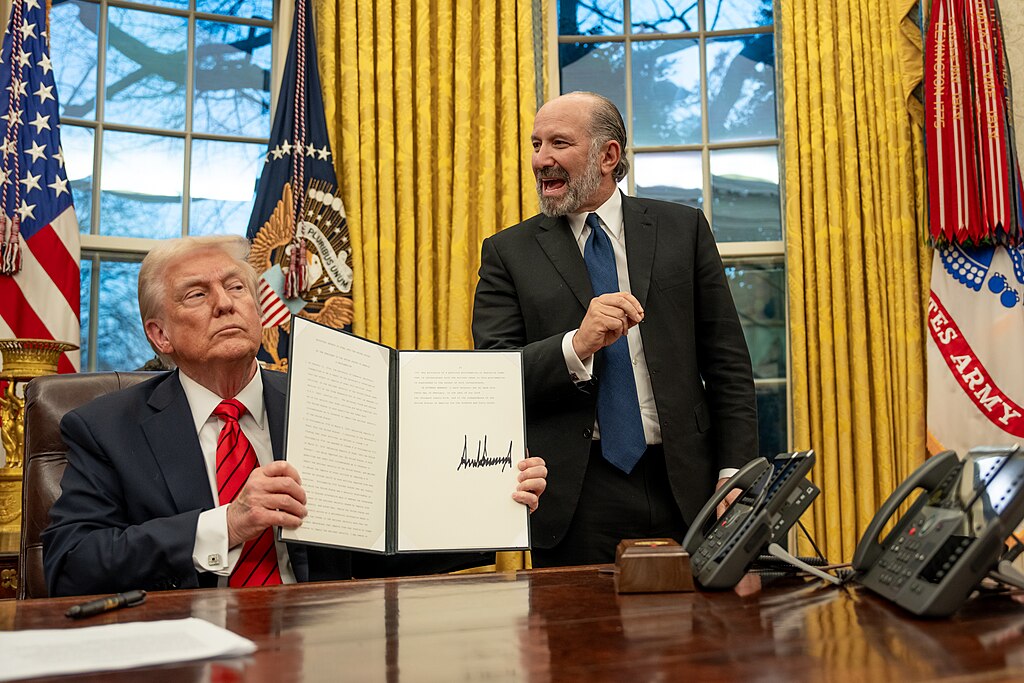
Just six months later, Lutnick got a major reward. In February 2025, Trump appointed him to the position of U.S. Secretary of Commerce, making him the top economic advisor to the White House with the task of expanding domestic industry and international trade. Since then, Lutnick has remained one of Trump’s most loyal friends and closest advisors on matters like crypto and tariffs. Reporters say that Lutnick often chats with Trump at 1am and joins him for ice-cream sundaes most Friday evenings.
And like many others in Trump's inner circle, he loves to champion his boss. "With President Trump, capitalism has a new sheriff in town. We’re not asking permission or seeking approval. We are here to declare that the era of America Last has come to an end,” Lutnick wrote in the Financial Times newspaper in early 2026. “Global investors understand that capitalism and their success is protected when America is strong, and the world respects our military. When we win, the world wins."
So apparently does Cantor Fitzgerald. In the past 12 months, Cantor Fitzgerald grew its projected revenue to US$2.5 billion, a 25 percent jump from the previous year. Individual bankers at Cantor booked twice as much revenue as their counterparts at more famous Wall Street banks.
Government watchdogs say that Howard Lutnick and Cantor Fitzgerald are milking his new job for as much as they can. “In this administration the conflicts are so pervasive and rife, but I think it's fair to say that Lutnick does stand out,” Robert Weissman, co-president of Public Citizen, told Salon, an online news site. “I think he gets a five-star rating for conflicts of interest.”
“President Trump’s billionaire Commerce Secretary has been playing the ultimate Washington insider game to pad his family’s riches,” said Tony Carrk, executive director of Accountable.US. “From the White House, Howard Lutnick has played a leading role in orchestrating Trump’s Bitcoin reserve policy at the same time his family company was pumping hundreds of millions of dollars into the biggest corporate Bitcoin holder in the game – pushing up their stake by at least [US]$300 million.”
Lutnick’s Legacy Howard Lutnick was a protégé of Bernie Cantor, the founder of Cantor Fitzgerald, who mentored him in the ways of Wall Street. Soon after Cantor’s health began to fail in 1990, Lutnick launched an acrimonious battle with the board and seized control of the bank in 1996. “Howard Lutnick has betrayed the trust I placed in him" by "taking advantage of my current medical condition" to "declare himself the sole managing general partner" of the firm, Bernie Cantor wrote in a letter to the other partners. Over the next 35 years that he ran Cantor Fitzgerald, Lutnick was known on Wall Street for his aggressive and questionable business practices such as self-dealing and shoddy record keeping, as well as for treating his staff badly, according to a Forbes magazine profile of him. Indeed one of his former partners described Lutnick as “the most hated guy on Wall Street.” Data from Violation Tracker backs up the Forbes summary of the bank’s business practices – it shows that Cantor Fitzgerald has paid over US$48 million in fines in the last 5 years. For example, in 2022, the CFTC fined Cantor US$6 million for poor record keeping. In 2023, Cantor was fined US$1.4 million by the SEC for reporting failures. In 2024, the SEC again fined Cantor US$6.75 million for making misleading statements about special purpose acquisition companies that it had set up. An egregious example of Cantor’s business practices was a 2006 scheme to deploy its banking technology in Nevada to allow people to make sports bets over mobile phones. In order to ensure profits, Cantor cut deals with infamous underworld rings to bet against their own customers. A 2025 report in Politico, an online news site, on the Nevada scheme concluded that although Howard Lutnick did not run Cantor Gaming on a day-to-day basis, he was “not an absentee owner of Cantor Gaming. He traveled regularly to Nevada to oversee the company’s operations.” In 2016, the company was fined US$16.5 million for money laundering and illegal gambling. “Cantor Gaming quickly grew into one of the largest race and sports book operators in the United States,” Robert Capers, the U.S. attorney for the eastern district of New York, said in a press release. “Unacceptably, this growth came at the expense of compliance with the law, and as a result Cantor Gaming became a place where at least two large-scale illegal bookmakers could launder their ill-gotten proceeds.” |
CRYPTO
Tether is the world’s biggest issuer of stablecoins, but it has long struggled with legitimacy in the U.S. for two reasons: links to illicit activities like drug trafficking, money laundering and sanctions busting, and a veil of secrecy that it has maintained on where it holds the financial assets that back up the stablecoins it has issued. All this changed in 2021, when Tether quietly struck a deal with Cantor Fitzgerald to take custody of some US$39 billion in U.S. treasury bills, in exchange for tens of millions of dollars in annual fees.
Soon after, Howard Lutnick arranged for Cantor to pay some US$500 million to Tether to acquire a five percent stake in Tether. The bank is now helping Tether to raise US$15 billion to US$20 billion from other investors in exchange for a three percent stake. If the other investors agree to the terms, Tether will be worth US$500 billion, which would result in a US$25 billion payday for Cantor Fitzgerald.
Cantor is also involved in other cryptocurrencies. For example, the bank helped Trump Media & Technology Group, which is majority owned by President Trump, collect US$2.5 billion from institutional investors to invest in bitcoin.
Not surprisingly Howard Lutnick was appointed as a member of a presidential crypto working group that Trump established via executive order to promote “lawful and legitimate dollar-backed stablecoins worldwide” and whose mandate involves reviewing regulations to be changed or abandoned.
To that end, Lutnick used his soapbox as Commerce Secretary to promote crypto. “We’re using the blockchain. We’re using bitcoin. We are going to use digital assets to pound forward, and Donald Trump is leading the way,” he told a White House summit on the topic in March 2025.
Critical Metals Cantor Fitzgerald is a major investor in Critical Metals Corp, which has a permit to mine critical minerals in Greenland. The mining company has received a US$120 million loan from the U.S. Export-Import Bank. Notably, Trump has threatened to annex Greenland in order to gain access to critical minerals deemed essential for the tech industry as they are used in smartphones, laptops, electric vehicles and other products. |
DATA CENTERS
The Newmark Group, a real estate company owned by Cantor Fitzgerald, estimated that it had completed over US$25 billion in data center deals in 2025 alone.
Leading that list of deals was US$7 billion in loans raised for Stargate’s first data center in Abilene, Texas, which analysts expect will use gas piped by Energy Transfer.
Another major deal announced by Newmark is a US$350 million loan for the Fermi Data Center project in Amarillo, Texas, which also benefits from gas piped by Energy Transfer. In addition, Cantor Fitzgerald helped Fermi issue shares in early October that valued the company at over US$12.5 billion.
Howard Lutnick and his sons have openly promoted the Fermi project. The father posed for a photo with Fermi CEO Toby Neugebauer in August 2025. Just months later Brandon Lutnick and his older brother Kyle Lutnick (who serves as executive vice chairman of Cantor Fitzgerald) boasted about cutting deals with Fermi in late 2025.
Newmark is also helping advise on US$4 billion in financing for the CoreWeave data center project in Lancaster, Pennsylvania.
Once again Howard Lutnick is cheerleading the industry. He joined Donald Trump at a conference in Pittsburgh in July 2025 that highlighted the Lancaster project. “The AI revolution is upon us,” Lutnick told attendees. “The Trump administration will not let us lose. We need to do clean, beautiful coal. We need to do natural gas, we need to embrace nuclear, we need to embrace it all because we have the power to do it and if we don’t do it, we’re fools.”
Rumble Cantor Fitzgerald arranged for Tether to buy US$775 million of shares in Rumble, a video platform favored by Trump-supporting influencers. The deal was completed shortly after Trump’s second inauguration. This has been very helpful for the Truth Social platform, run by Trump Media and Technology Group, which uses Rumble’s ad network. Donald Trump Jr., Trump’s son, has a ”seven-figure” deal with Rumble for the platform to exclusively carry his biweekly podcast. And Chris Pavlovski, founder and CEO of Rumble, was given a “new media” seat at the White House’s daily press conference on February 12, 2025. |
Related Articles
A couple of months before the November 2024 election, a curious document landed in investors' inboxes. Titled the “World Liberty Gold Paper” and emblazoned with a stern-looking picture of Donald Trump in a coin-shaped splash of gold, it announced the Trump family’s entrée into the world of cryptocurrencies. Read More